

.png)
Get in touch with us for inquiries, collaborations, or service requests.
Our team will respond as soon as possible.

News
What Is an Optical Trocar? Function, Types & Comparison Guide
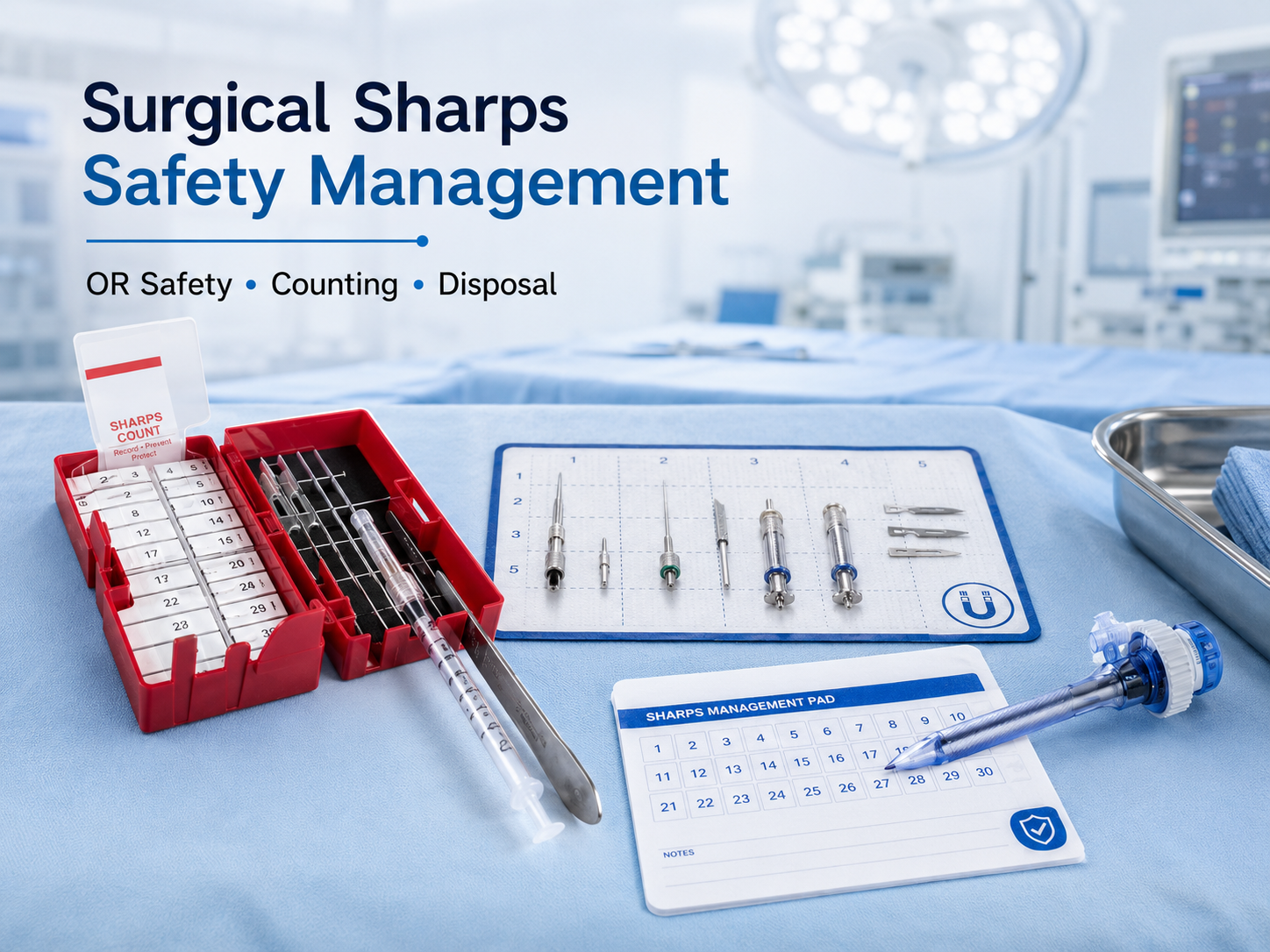
This technical article explains the design principles of an optical trocar, details how it enables real-time tissue layer visualization during laparoscopic entry, compares its benefits with classic and bladeless trocars, and outlines core procurement metrics for global medical device distributors and private label OEM sourcing systems. For a comprehensive overview of accompanying operating theater equipment, see: Surgical Sharps Safety Management & OEM Sourcing Guide.
What Is an Optical Trocar?
An optical trocar is a highly specialized laparoscopic access device engineered to permit continuous visual confirmation of tissue layers during insertion into the abdominal cavity. Unlike classic or tissue-separating models, an optical trocar features an advanced, ultra-clear transparent obturator housing that accommodates a standard surgical endoscope. This configuration empowers the surgical team to directly observe distinct anatomical tissue planes in real time as the cannula is advanced through the abdominal wall, significantly reducing blind entry variables.
Optical trocars are extensively utilized throughout high-standard minimally invasive surgery (MIS) procedures, clinical lap operations, and specialized diagnostic methods where real-time visualization during primary port placement represents a critical safety checklist directive or a primary surgeon workflow preference.
Operating as a core pillar within modern laparoscopic port access portfolios — alongside specialized disposable bladeless trocars and cost-effective disposable classic surgical trocars — the premium optical access cannula delivers a highly controlled mechanical approach within a standardized laparoscopic access system.
How Does an Optical Trocar Work?
The defining technological feature of an optical access device resides in its custom-extruded transparent or translucent obturator tip. This high-purity polymer structure allows a standard 0° laparoscope optical assembly to be loaded directly through the cannula core prior to penetration. As the surgeon exerts controlled downward axial pressure, the integrated camera streams real-time visual definitions of every layer—the epidermis, subcutaneous fat, fascia strands, muscle bundles, and the final translucent peritoneum layer — as the tip advances.
Step-by-Step Port Entry Pathway
- A pre-sterilized 0° laparoscope is guided and locked into the transparent obturator chamber of the optical trocar system.
- The assembled cannula tip is aligned at the skin incision marker or umbilical entry point.
- Controlled forward pressure is exerted, allowing the surgeon to monitor tissue layer separation live via the theater video monitors.
- Upon sudden visual confirmation of the open peritoneal cavity space, the forward advance is immediately halted.
- The internal optical obturator is unlocked and retracted, leaving the non-conductive sleeve cannula safely seated as the primary working access channel.
This precise visual feedback loop thoroughly differentiates the optical device from traditional entry methods, where abdominal penetration relies entirely on haptic tactile resistance pops or pre-established landmark indexing alone.
Optical Trocar vs Classic Trocar vs Bladeless Trocar
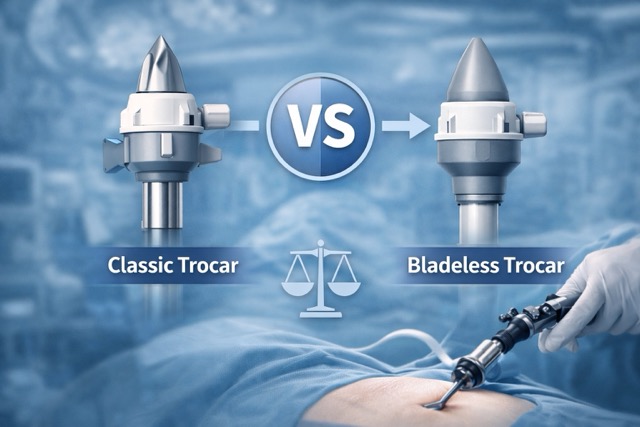
Evaluating the mechanical and structural properties that distinguish the three primary trocar groups helps hospital procurement lines and biomedical engineers select the right toolset mix for each specialized surgical setup. For an expanded technical breakdown detailing classic and tissue-separating components, see: Bladeless Trocar vs Classic Trocar — Key Differences & Selection Guide.
| Technical Configuration | Classic Trocar | Bladeless Trocar | Optical Trocar |
|---|---|---|---|
| Obturator Tip Profile | Linear or pyramidal sharp steel blade | Blunt polymer tissue-separating fins | High-purity clear transparent lens housing |
| Layer Visual Oversight | No — blind puncture entry | No — tactical dilation entry | Yes — real-time tissue visualization |
| Optics Channel Fit | Incompatible during primary placement | Incompatible during primary placement | Yes — integrated 0° endoscope sleeve |
| Tissue Penetration Style | Mechanical shearing and cutting | Anatomical fiber stretching and dilating | Visually guided separation or micromechanical path |
| Optimal Scenario | Standardized cost-capped procurement | Low-trauma, muscle-sparing approaches | Complex wall entry requiring step-by-step review |
| Peripheral Gear Required | None beyond basic trocar block | None beyond basic trocar block | Active 0° camera probe during path insertion |
When Are Optical Trocars Used in Laparoscopic Surgery?
Optical access instrumentation is selected in advanced laparoscopic setups where immediate image tracking during abdominal perforation represents a critical procedural preference. Primary clinical indications incorporate:
Complex Abdominal Anatomies
Patients presenting variable muscular frameworks or thicker adipose profiles, where layer-by-layer visual tracking lowers accidental puncture risks.
Reoperative or Post-Adhesion Settings
Cases with history of peritonitis or prior abdominal scars, where internal tissue adhesion tracks require visual path identification to secure access lanes.
Rigid Institutional Checklists
Surgical centers specifying optical dilation as the mandatory safety baseline for the deployment of the initial primary camera port system.
Surgeon Method Preference
Advanced laparoscopic specialists trained extensively with optical dilation platforms routinely mandate these components for their standard MIS arrays.
Disposable optical ports represent an integral technological block within the broader minimally invasive surgery (MIS) device ecosystem, operating alongside high-performance suction irrigation channels, smoke evacuation filtration sets, tissue retrieval bags, and operating theater safety consumables.
Optical Trocar Sizes and Configurations
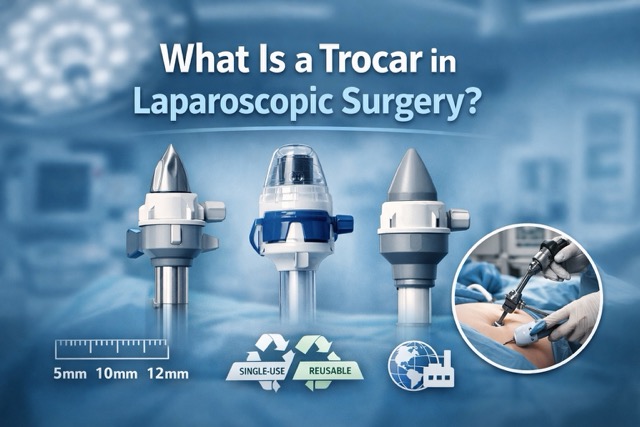
To assure perfect cross-compatibility with widespread operating room instrumentation lines, optical ports are fabricated in strict alignment with international mechanical diameter definitions:
- 5 mm Cannulas — Accommodates compact laparoscopic hand tools, needles, and micro-scissors requiring localized visual access.
- 10 mm Cannulas — The universal benchmark size, built to fit standard 0° optical laparoscopes seamlessly.
- 12 mm Cannulas — Configured for high-volume tools, endo-staplers, or specimen retrieval rings requiring simultaneous visual access control.
Our standard production configures these models in an effective 100mm cannula length optimized for universal abdominal wall metrics, ensuring excellent flexibility for international distributor distribution programs.
Single-Use Optical Trocars for Infection Control
To fully mitigate patient cross-contamination hazards and reduce hospital sterile supply processing overheads, global hospital procurement frameworks prioritize single-use, disposable access devices. Premium disposable optical ports provide distinct clinical benefits, being:
- Ethylene Oxide (EO) gas sterilized and packed in individual high-barrier peel pouches for immediate, reliable operating theater deployment.
- Documented with complete batch traceability markers, sterilization tags, and unique barcode labeling.
- Fully compliant with international ISO 13485:2016 specifications, active CE MDR standards, and CFDA quality guidelines.
- Optimized for turnkey contract private label molding and tailored OEM branding programs.
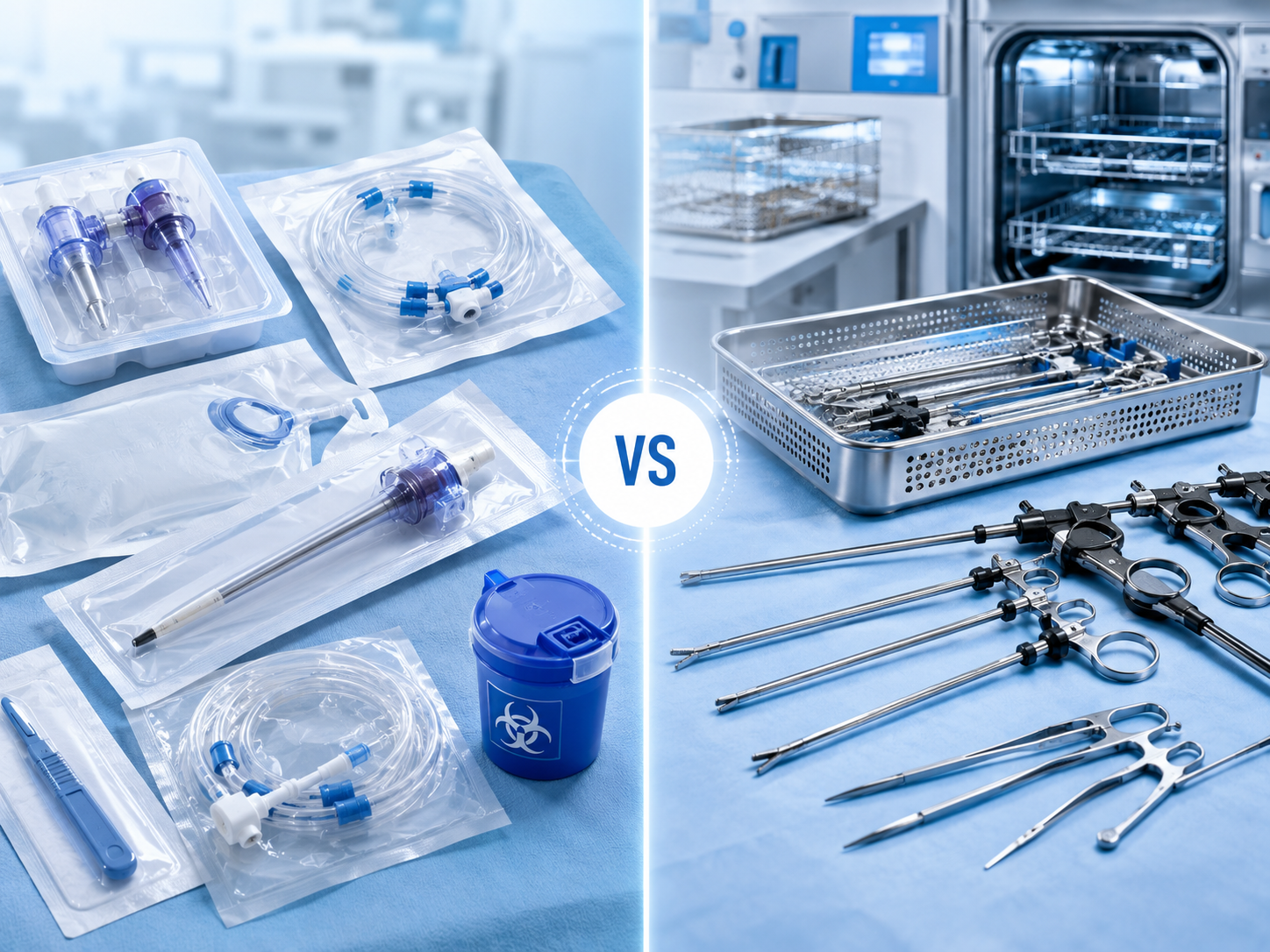
For a granular financial and clinical risk comparison evaluating single-use versus reusable tool sets across volume hospital tenders, see: Disposable vs Reusable Surgical Consumables — Procurement Comparison for Global Buyers.
Optical Trocar Procurement and OEM Sourcing Considerations
For high-volume medical consumable distributors, international brand networks, and OEM contract clients, auditing manufacturing technical parameters involves critical milestones:
B2B Procurement Checklist — Laparoscopic Access Devices
- Obturator Transparency Metrics — Clear polymer material must support precise, non-glare high-definition visual pathways under theatre bulbs.
- Endoscope Sleeve Tolerances — Precise internal dimensions to fit multi-brand 5mm or 10mm scope shafts tightly without rattling.
- SKU Completeness Options — Full capability spanning 5mm, 10mm, and 12mm sizing parameters from a unified factory.
- Valve Seal Integrity — Premium double-layer airtight gaskets to enforce superior pneumoperitoneum gas control during instrument transitions.
- Sterilization Validation Compliance — Documented gas saturation validation tracking in compliance with ISO 11135 directives.
- International Certification Tracking — Verified CE MDR clearances, ISO 13485 quality credentials, or CFDA approvals for destination ports.
- Private Brand Labeling Support — Complete capabilities for customized boxing layout formats, personalized graphics, and tailored SKU portfolios.
- Production Line Volume Stability — Scalable output capabilities, heavy raw plastic stockpiles, and reliable export lead times.
Laparoscopic access units are most efficiently acquired as part of an integrated, consolidated Laparoscopic Trocar Essentials Product Program. This framework empowers international wholesale distributors to merge classic, bladeless, and optical configurations with a single verified production partner.
Why Source Optical Trocars from Senmed Medical?
Operating under strict parameters, Senmed Medical provides over 20 years of OEM and ODM contract manufacturing mastery for global medical device brands. Our total surgical access portfolio spans Classic, Bladeless, and high-transparency Optical variations — enabling international distribution networks to simplify supply chains, documentation structures, and SKU logistics through a single verified manufacturing asset.
✔ Certified Manufacturing
Operates an ISO 13485 quality platform with active CE MDR and CFDA certifications. EO sterilization tracks conform strictly to ISO 11135 benchmarks with absolute material-to-casing lot tracking.
✔ Class 100,000 Cleanroom
A modern 700m² Class 100,000 cleanroom facility dedicated entirely to high-purity polymer injection molding, precision cannula assembly, and final pouch sealing, backed by on-site microbiology labs.
✔ Advanced Private Labeling
Comprehensive in-house DFM engineering, rapid mold prototyping, and tailored carton configurations, supporting specialized private label programs across the UK, US, Europe, Australia, and Asia.
✔ Holistic Laparoscopic Group
Consolidate your catalog seamlessly with our companion lines, encompassing high-flow suction irrigation sets, insufflation smoke filters, specimen bags, microscope sheaths, and core OR consumables.
View Optical Trocar Specifications
Download comprehensive product dimensions, validation parameters, and available private branding setups.
Frequently Asked Questions About Optical Trocars
What is the main difference between an optical trocar and a classic trocar?
The fundamental difference is real-time visualization. An optical trocar features a clear polymer obturator housing that accommodates an active 0° laparoscope, enabling surgeons to visually monitor abdominal muscle planes and blood vessel locations during entry advancement. In contrast, a classic trocar utilizes a sharp steel cutting blade tip to force entry via a blind puncture path without optical verification.
What is the difference between an optical trocar and a bladeless trocar?
A standard bladeless trocar incorporates blunt, tissue-separating ridges that curve and stretch muscle fibers without a sharp blade, but it does not permit scope oversight during penetration. An optical trocar combines the clinical safety parameters of either a cutting or dilating obturator with a crystal-clear lens cap, adding real-time visualization by allowing the tracking camera to guide the full penetration track.
What size laparoscope is used with an optical trocar?
Standard, non-angled 0° rigid endoscopes are universally recommended with optical access cannulas during primary entry workflows. The tracking laparoscope shaft diameter must line up precisely with the trocar inner guide channel sleeve parameters—most commonly accommodating 5mm or 10mm fiber-optic bundles depending on the core SKU configuration selected.
Are optical trocars single-use or reusable?
To enforce perfect surgical fields and manage international cross-contamination laws, the overwhelming majority of modern hospital procurement programs mandate single-use, disposable access devices. Senmed disposable lines are pre-sterilized via Ethylene Oxide (EO) gas and packed in single peel-pouches, completely dropping hospital autoclave reprocessing parameters.
Can optical trocars be supplied through OEM or private label programs?
Yes. High-purity transparent ports, dilating access cannulas, and complete laparoscopic instrumentation kits are heavily sourced via automated high-volume OEM and ODM contract manufacturing channels for international medical brands. Senmed supports global procurement networks with scalable private label parameters, personalized box graphics, and integrated validation documents.
What certifications should I look for when sourcing optical trocars?
For frictionless universal customs clearance and distribution safety compliance, buyers must verify active CE MDR (European Medical Device Regulations) clearance, comprehensive ISO 13485 quality system certificates, ISO 11135 industrial gas sterilization validation registries, and active CFDA documentation maps for Asian hospital networks.
Request an Optical Trocar Sample or OEM Consultation
Senmed Medical supports global medical device distributors and private label brands with OEM and ODM optical trocar programs — including product sampling, regulatory documentation, custom packaging, and scalable supply chain solutions.
- CE MDR & ISO 13485 certified production framework.
- Classic, Bladeless, and Optical trocar — full entry portfolio from one single supplier.
- OEM / private label programs customized for UK, US, Europe, Australia, and Asia markets.
- Absolute Ethylene Oxide (EO) sterilization backed by ISO 11135 validation.
- Sample requests, DFM mold engineering, and production consultations available.