

.png)
Get in touch with us for inquiries, collaborations, or service requests.
Our team will respond as soon as possible.

News
What Is a Trocar in Laparoscopic Surgery? Sourcing Guide
This comprehensive guide explains the core clinical mechanics of a laparoscopic trocar, details the structural variances among the three dominant access types—classic bladed, tissue-separating bladeless, and camera-guided optical arrays—outlines universal size matrices, evaluates single-use versus reusable parameters, and outlines vital selection checklists for B2B procurement, contract private label manufacturing, and global distribution logistics. For a macro overview of integrated operating room device groups, see: What Is Minimally Invasive Surgery (MIS)? Devices & Disposable Systems Overview.
What Is a Trocar in Laparoscopic Surgery?
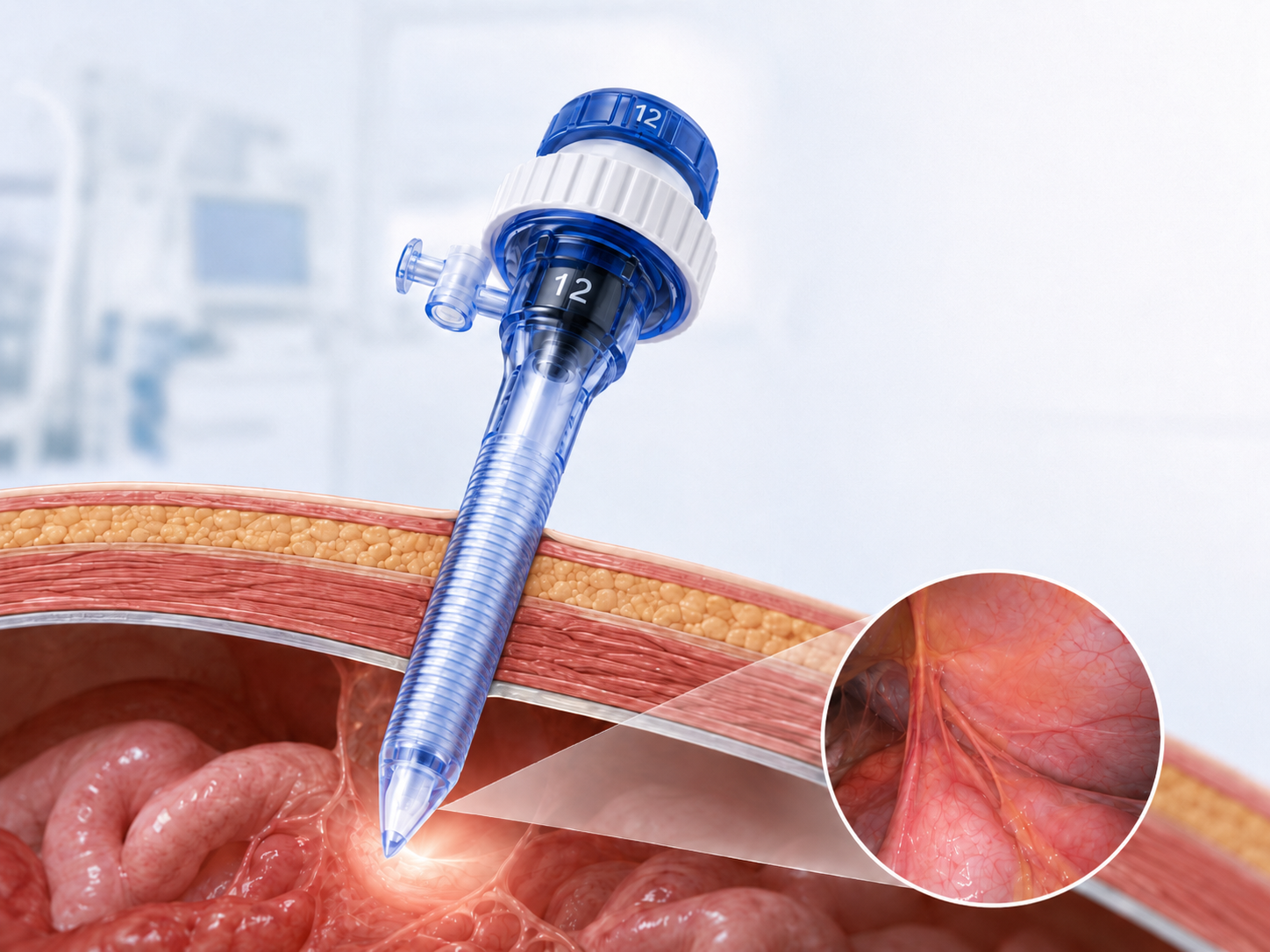
A trocar is a rigid, specialized surgical access instrument engineered to safely cross the abdominal muscle wall layers and establish a secure, fluid-resistant, and gas-sealed entry port into the peritoneal cavity. Once stationed within the wound margin, the trocar serves as a continuous, rigid conduit channel that allows fiber-optic laparoscopes and multi-axis surgical hand instruments to glide smoothly into the sterile workspace without disrupting internal pneumatic parameters.
Throughout the modern surgical landscape, these devices function as the absolute foundation of laparoscopic access systems, enabling precise instrument navigation and workflow standardization across general laparoscopic surgery, complex gynecological exposures, urological access pathways, and hybrid minimal access interventions.
What Is a Trocar Used For?
During minimally invasive laparoscopic procedures, trocar cannula networks are continuously utilized to execute critical structural tasks:
- Channel Creation — Establishing a non-collapsible entry pathway for endoscopes and delicate tissue graspers.
- Tool Turnaround Support — Permitting repeated instrument introduction and smooth tool retraction without tearing wound borders.
- Pneumoperitoneum Preservation — Sealing tightly around tool shafts to lock in carbon dioxide gas pressure, preventing cavity flattening.
- Specimen Extraction — Enabling visual tissue retrieval by accommodating mass specimen bags smoothly through the tube lumen.
- Tower Integration — Connecting flawlessly with automated CO₂ gas insufflation tubing and standard operating room equipment.
Types of Laparoscopic Trocars
Modern hospital procurement programs manage three primary trocar design groups, each custom-molded to support specialized insertion techniques and surgeon preferences:
1) Classic Trocars
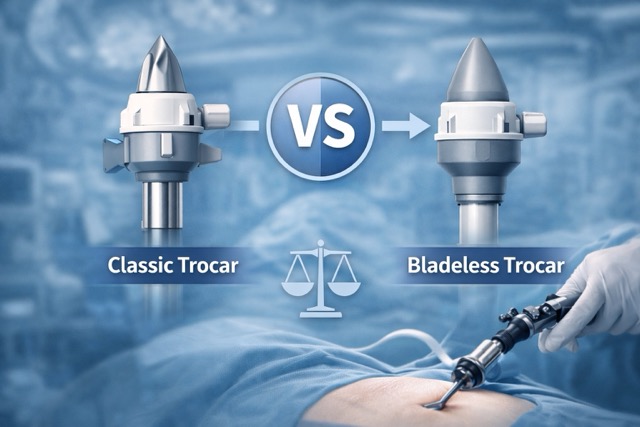
Traditional bladed options utilize a flat or pyramidal sharp steel edge profile built to cleanly puncture tissue layers, allowing rapid port entry. These systems incorporate double-layer airtight mechanical gaskets to deliver excellent air leakage control during instrument transition. They are fabricated across a standard 100mm effective cannula length in universal 5mm, 10mm, and 12mm diameters.
Bladed ports represent a highly cost-efficient, deeply standardized choice optimized for routine high-volume operations where procurement simplicity is a primary focus.
View factory product specifications: Disposable Classic Surgical Trocar — Senmed Medical
2) Bladeless Trocars
Bladeless models eliminate cutting blades entirely, achieving abdominal wall penetration via radial tissue separation. The custom obturator features blunt conical dilating fins that gently stretch and glide muscle fibers apart along their natural anatomical boundaries rather than slicing them linearly.
This mechanism provides high structural sleeve fixation against the skin, avoiding unexpected port dislodgements mid-case. For an in-depth technical analysis contrasting bladed cutting versus non-blade dilation tracks, see our specialized procurement guide: Bladeless Trocar vs Classic Trocar — Key Differences & Selection Guide.
View factory product specifications: Disposable Bladeless Trocar — Senmed Medical
3) Optical Trocars
Optical ports integrate a crystal-clear, ultra-transparent polymer lens tip that accommodates a 0° laparoscope camera probe inside the obturator sleeve. This engineering configuration allows the surgical team to directly monitor the visual progression through every individual tissue plane (skin, fat, fascia, muscle, and peritoneum) in real time on the video screens during advancement.
This continuous image tracking eliminates blind insertion guessing, satisfying rigid institutional safety checklists and complex post-adhesion entry requirements. For a complete analysis breaking down lens clarity and scope channel parameters, see: What Is an Optical Trocar? Function, Design & Sourcing Guide.
View factory product specifications: Disposable Optical Trocar with Clear Cannula — Senmed Medical
Common Trocar Sizes and Configurations
Laparoscopic access ports are extruded in precise, standardized universal diameters to align with universal surgical hand tools:
- 5 mm Cannulas — Positioned as auxiliary ports to pass compact laparoscopic hand instruments, micro-forceps, and scissors.
- 10 mm Cannulas — The universal standard channel, engineered to accommodate rigid endoscope visualization cameras and standard tools.
- 12 mm Cannulas — Wide-bore sleeves configured to pass large instrumentation, mechanical staplers, and circular Disposable Laparoscopic Specimen Retrieval Bag Series configurations requiring broad lumen margins during tissue withdrawal.
Single-Use vs Reusable Trocars
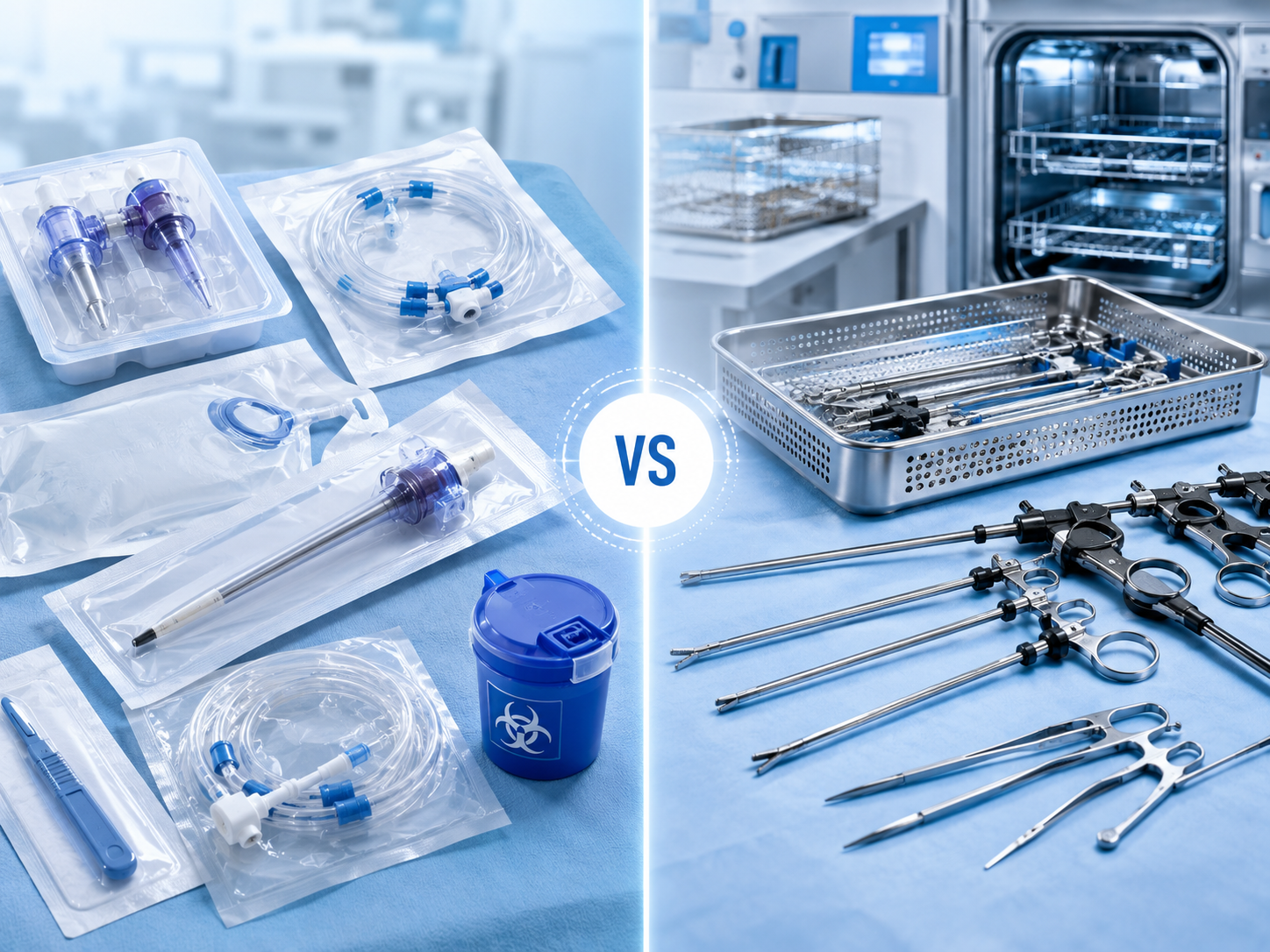
To strictly enforce modern infection control baselines and lower cross-contamination liabilities, global universal hospital purchasing clusters prioritize single-use, disposable access devices. Pre-sterilized disposable trocars arrive packaged in clean high-barrier peel pouches processed with ring-validated Ethylene Oxide (EO) gas, completely dropping on-site hospital manual cleaning, enzymatic chemical washing, and autoclave validation cycles.
While multi-use reusable setups remain limited to capital equipment asset structures with large central cleaning plants, single-use ports deliver a entirely fixed, predictable per-case procurement expense. For an absolute total cost of ownership (TCO) and sterile processing department labor cost comparison, see: Disposable vs Reusable Surgical Consumables — Procurement Comparison for Global Buyers.
How to Choose the Right Trocar
When selecting a dependable entry manufacturer for international distributor distribution or private brand contract programs, clinical buyers screen four major milestones:
Procedural Sizing Match
Cannula sleeve selections must provide standard 5mm, 10mm, and 12mm SKU combinations to fulfill diverse surgical checklist demands easily.
Airtight Valve Efficiency
Gasket compounding materials must maintain zero gas drop variables under intensive tool triangulation, securing steady pneumoperitoneum levels.
Cleanroom Validation
Injection molding, automated trimming, and sealing must be executed entirely inside verified Class 100,000 positive-pressure cells to satisfy bio-burden limits.
Regulatory Readiness
Sourcing channels must hold active CE MDR certifications, ISO 13485 quality systems, and target market validation maps (such as CFDA or FDA registries).
For an absolute technical roadmap on vetting contract medical device factories — covering in-house mold labs and design-for-manufacturability (DFM) support — see our global sourcing analysis: How to Choose a Surgical Consumables OEM Manufacturer.
Trocar Devices in OEM and Global Supply Chains
For international private brand managers and high-volume distribution channels, consolidating your complete access catalog with a single manufacturing partner optimizes logistics pipelines and removes component dimension mismatch anomalies. Senmed Medical structures comprehensive private label contract services, customizing pouch printing layouts, multi-language instructions for use (IFU), and unique SKU barcode branding to simplify procurement frameworks for markets across the UK, US, Europe, Australia, and Asia. View our full commercial entry matrix at our dedicated product index: Disposable Laparoscopic Trocar Essentials.
Why Source Laparoscopic Trocars from Senmed Medical?
Operating as a specialized, certified manufacturer of disposable minimal access devices, Senmed Medical (Dongguan Senmed Medical Instrument Co. Ltd.) delivers over 20 years of intensive OEM and ODM manufacturing experience. Our fully integrated trocar program empowers international medical device networks to source classic bladed cutting ports, tissue-separating dilating cannulas, and camera-guided optical ports from a single, verified contract manufacturing facility.
✔ Certified Manufacturing
Maintains strict ISO 13485 quality infrastructures alongside active CE MDR and CFDA certifications. EO gas processing tracks conform fully with ISO 11135 criteria with complete material lot-to-shipment tracking records.
✔ 700m² Class 100,000 Cleanroom
Automated high-purity polymer injection molding, precision manual cannula tracking assembly, and blister pouch heat sealing are executed entirely inside positive-pressure air cleanrooms, verified by on-site microbiology labs.
✔ Turnkey private Label Sourcing
Comprehensive in-house mold tool development, rapid prototyping capabilities, custom cannula length modifications, and specialized carton branding configurations engineered for universal medical brand distributions.
✔ Holistic MIS Catalog Integration
Consolidate your entire surgical consumable procurement seamlessly beside our companion categories, encompassing high-flow suction irrigation channels, insufflation smoke filters, specimen retrieval bags, microscope camera sleeves, and skin frames.