

.png)
Get in touch with us for inquiries, collaborations, or service requests.
Our team will respond as soon as possible.

News
Bladeless Trocar vs Classic Trocar: Sourcing Guide
This technical article establishes a procurement-focused comparison between disposable bladeless trocars and classic bladed cannulas. It outlines their structural design differences, tissue layer insertion properties, typical clinical applications, universal sizing options, and vital decision factors for laparoscopic access selection within minimal access hospital protocols. For an expanded technical breakdown detailing real-time camera-guided dilation options, see: What Is an Optical Trocar? Function, Design & Sourcing Guide.
Executive Procurement Summary
Laparoscopic access pathways increasingly utilize a strategic mixture of specialized entry conduits based on tissue-entry policies. Choosing between bladeless trocar vs classic trocar architectures involves balancing absolute case-by-case cost efficiency alongside rigid institutional tissue-sparing trauma parameters.
Understanding Trocar Selection in Laparoscopic Surgery
Throughout modern What Is Minimally Invasive Surgery (MIS)? Devices & Disposable Systems Overview setups, laparoscopic ports serve as the mechanical foundation to establish, expand, and isolate entry paths through the patient abdominal wall for fiber-optic cameras and instrumentation. Among the most widely adopted setups managed within global healthcare tenders are classic trocars and bladeless trocars.
While both access configurations achieve the same fundamental operational goal—preserving pneumatic gas sealing under continuous instrument manipulation—their engineering geometries, entry force tracks, and abdominal wall fixation characteristics vary significantly. These technical properties represent critical considerations for hospital procurement planning, distributor SKU consolidation, and operating room checklist standardization.
What Is a Classic Trocar?
A classic trocar incorporates a traditional blade-tip obturator engineered to execute a precise, clean puncture path through muscle fascia layers to instantly advance the cannula sleeve. This mechanism remains a deeply standardized, widely accepted baseline option for routine laparoscopic procedures across global distribution networks.
Key Engineering Highlights
- Linear or pyramidal sharp steel blade obturator — drives quick penetration with low initial skin tenting force.
- Double-layer integrated valve matrix — enforces exceptional carbon dioxide gas retention and pneumoperitoneum control during rapid tool replacement.
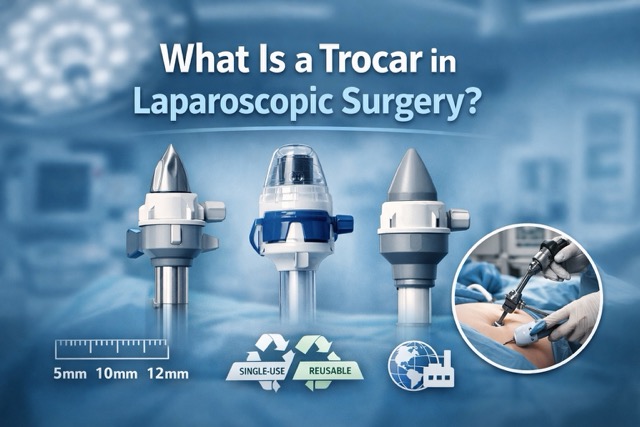
- Universal diameter allocations — supplied in 5mm, 10mm, and 12mm diameters to cover widespread instrument brands.
- Standardized 100mm effective cannula length — provides reliable working reach within routine abdominal structures.
- Ready-to-use EO sterilization — delivered in high-barrier individual pouches with full batch traceability logs.
Disposable bladed options are heavily prioritized within high-volume clinical centers where consistent mechanical performance, absolute cross-brand tool fitting, and optimized cost-per-procedure metrics represent primary goals. View full factory specifications: Disposable Classic Surgical Trocar — Senmed Medical.
What Is a Bladeless Trocar?
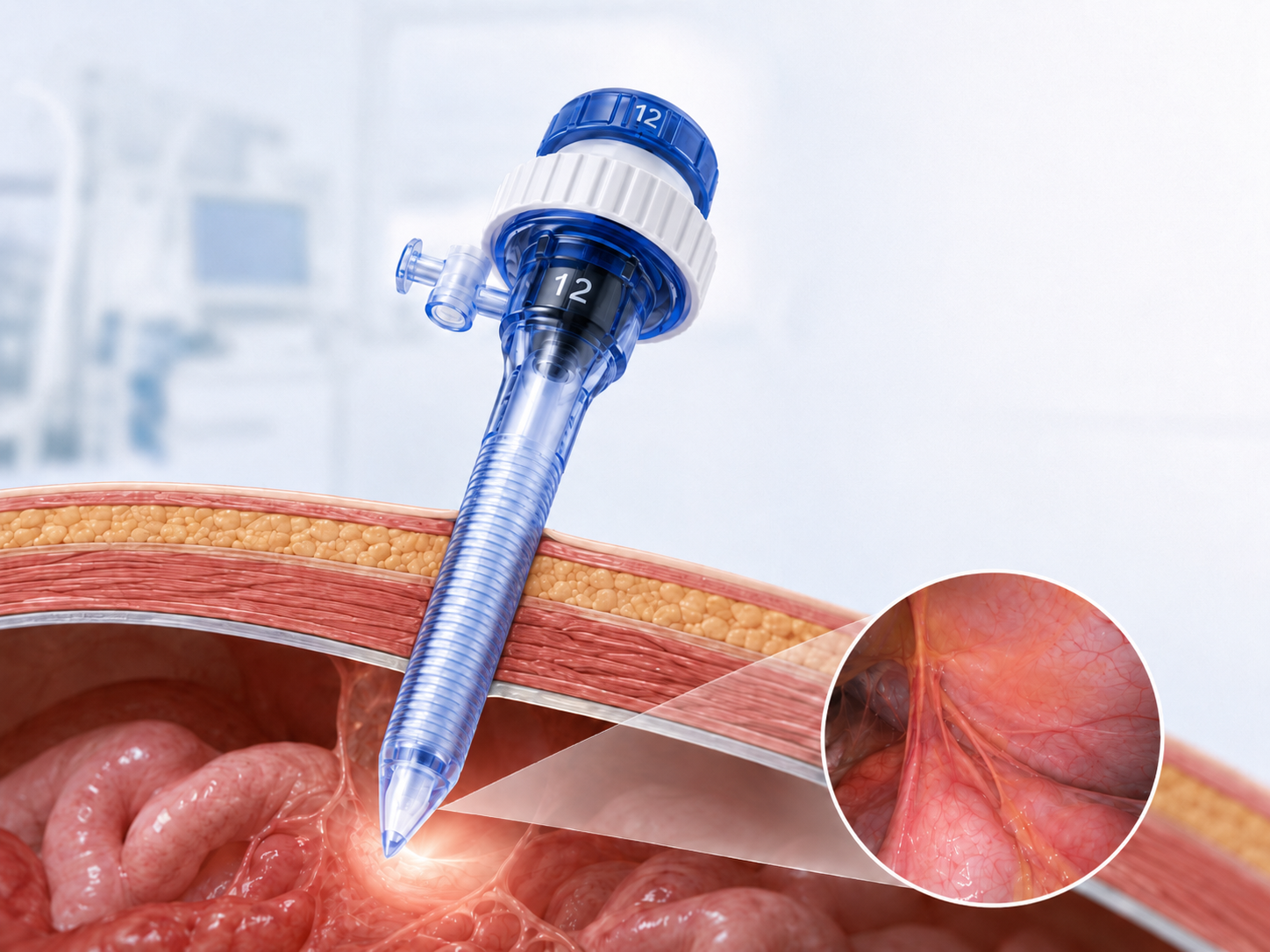
A bladeless trocar establishes a reliable working channel by achieving radial tissue separation rather than executing a sharp mechanical incision. The custom-molded obturator utilizes an anatomical dilating tip that curves, stretches, and glides muscle fibers aside along their natural boundaries during advancement.
Key Engineering Highlights
- Blunt tissue-separating obturator profile — expands muscle strands anatomically, eliminating the threat of sharp vascular slicing.
- Zero mechanical blade components — relies entirely on soft multi-axis radial dilation pathways.
- High-retention airtight gasket rings — sustains steady gas volume balances under extreme tool triangulation angles.
- Standardized universal diameter sizing — allows frictionless passage of advanced clip appliers and endo-staplers.
- Pre-sterilized single-use disposable layout — satisfies international hospital infection prevention standards.
Dilation-style access sleeves are highly specified across clinical settings prioritizing non-cutting abdominal wall entry, which delivers strong structural abdominal port fixation to minimize unexpected cannula slip-outs. View full factory specifications: Disposable Bladeless Trocar — Senmed Medical.
Bladeless Trocar vs Classic Trocar: Side-by-Side Comparison
This data-driven checklist clarifies the primary mechanical variances dictating global B2B supplier selection:
| Technical Attribute | Classic Trocar (Bladed Models) | Bladeless Trocar (Dilation Models) |
|---|---|---|
| Obturator Tip Geometry | Pyramidal or linear steel cutting blade | Blunt polymer conical tissue-separating fins |
| Port Entry Methodology | Mechanical incising and shearing | Anatomical fiber stretching and dilation |
| Camera Tracking Overlap | Incompatible during path advance | Incompatible during path advance (Tactile feedback only) |
| CO2 Sealing Integrity | Double-valve system; airtight tool swaps | High-friction elastomer gaskets; pressure stability |
| Diameter Sizing Portfolio | 5mm / 10mm / 12mm x 100L sleeves | 5mm / 10mm / 12mm x 100L sleeves |
| Supply Lifecycle Model | Sterile single-use disposable layout | Sterile single-use disposable layout |
| Primary Sourcing Driver | High cost-predictability; routine access channels | Non-blade protocols; high abdominal fixation specs |
| Contract OEM Labeling | Supported via custom packaging | Supported via custom packaging |
Key Differences Between Bladeless and Classic Trocars
1. Structural Tip Design
The foundational differentiator. Classic bladed variants cut through dermis tissue via physical steel edges, creating an explicit linear path. Bladeless models utilize engineered dull profiles to spread muscle strands apart cleanly without sharp incising.
2. Path Deflection Force
Classic trocars generate an effortless cutting movement through thick aponeurotic bands under traditional mechanics. Bladeless systems create a radial friction path that requires a deliberate rotating hand pressure to widen muscle lines during insertion.
3. Tissue Anchor Profile
Because bladeless dilation separates instead of cuts, the surrounding abdominal walls naturally contract tightly around the cannula barrel. This creates strong mechanical hold, preventing unexpected port slippage during rapid handpiece maneuvers.
4. Institutional Workflow Strategy
Device selection is frequently driven by traditional clinical background markers, local healthcare risk frameworks, and pre-established surgical protocols rather than a single technical metric. Both modalities dominate current global medical tenders.
5. Portfolio SKU Consolidation Strategy
Both access selections use matching diameter thresholds (5mm / 10mm / 12mm) and individual sterile casing formats. For wholesale distributors, managing both traditional cutting and non-blade dilating portfolios under a single contract OEM supplier allows for total clinical market placement using one verified manufacturing channel.
When to Choose a Classic Trocar vs a Bladeless Trocar
Neither access instrument configuration is universally superior; selection is dictated by specialized target procedure parameters and hospital administrative constraints:
Classic Trocar — Selected When:
- Standardized, routine high-speed laparoscopic entry configurations are mandated.
- Maximizing cost predictability across cost-capped global state tenders represents a main priority.
- Clinical networks utilize traditional, high-velocity perpendicular incision methods.
- Sourcing massive, highly predictable inventory lot volumes with zero custom design latency.
Bladeless Trocar — Selected When:
- Hospital sensory guidelines specifically request a non-blade entry system.
- Surgical centers request superior, high-friction cannula sleeve retention tracking parameters.
- Specialists request maximum tissue-sparing dilation tracks around highly sensitive port zones.
- B2B distribution lines require deep, differentiated SKU options to expand market penetration.
Single-Use Configurations for Both Trocar Types
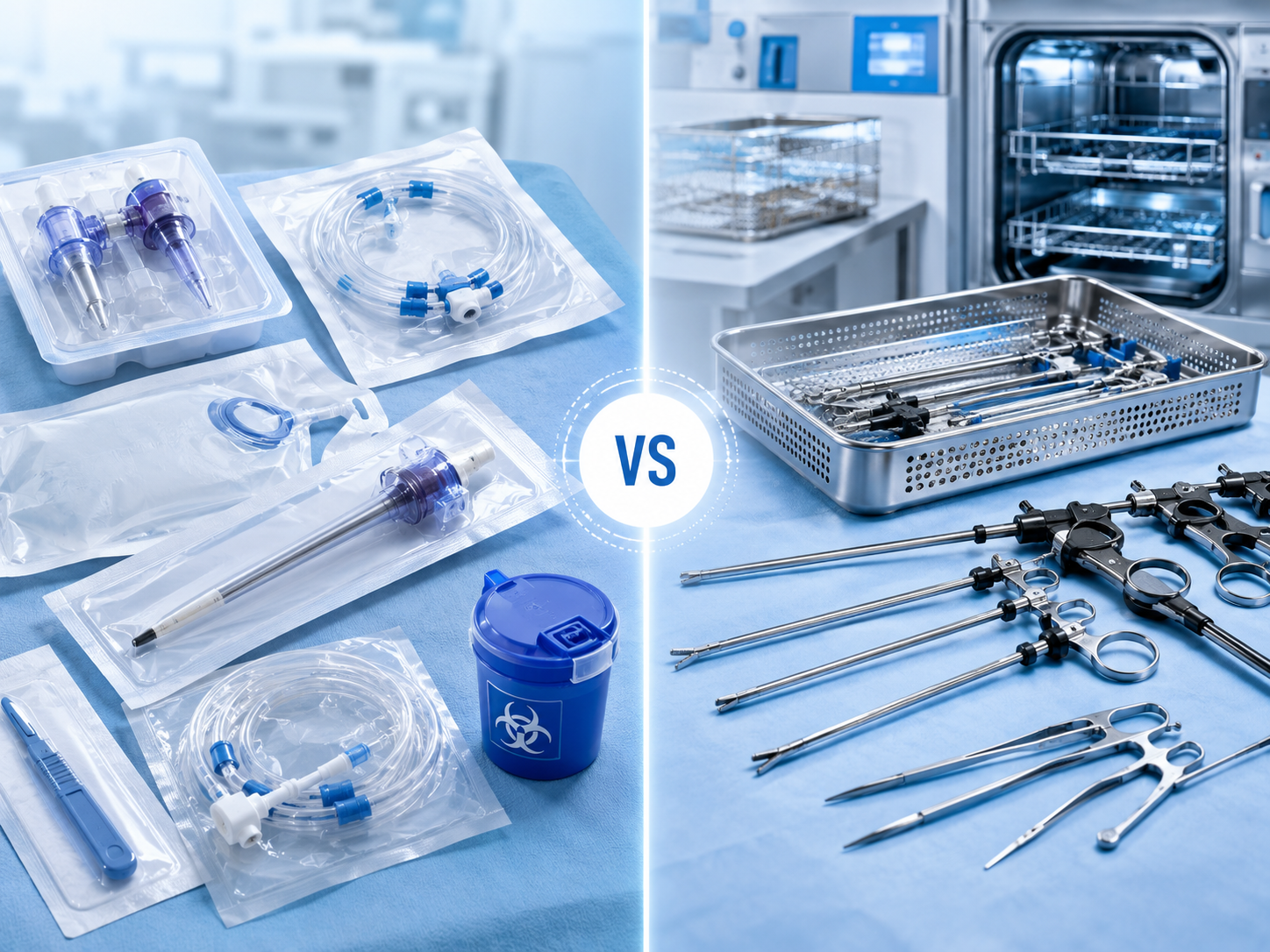
To eliminate hospital cross-infection vulnerabilities and optimize cleanroom validation cycles, modern medical systems utilize single-use, disposable devices. Both Senmed access selections arrive pre-sterilized via ring-validated Ethylene Oxide (EO) gas systems, offering:
- Absolute compliance with active operating room microbial isolation metrics.
- Elimination of complex hospital autoclave validation loops and manual cleaning labor overheads.
- Predictable per-case budgeting matrices optimized for multi-year healthcare contracts.
- Active certification tracking including CE MDR clearances, ISO 13485:2016 quality marks, and CFDA validation data.
For a granular review tracking cost amortization curves between multi-use hardware and sterile disposable channels, see: Disposable vs Reusable Surgical Consumables — Procurement Comparison for Global Buyers.
Where Does the Optical Trocar Fit?
Beyond bladed and standard non-blade configurations, advanced surgical environments leverage a third distinct class: the optical trocar. This tool is specified when real-time visual confirmation of tissue layers during insertion represents a necessary safety checkpoint or institutional mandate.
Unlike classic cutting or tactile bladeless dilation sleeves, optical ports mount an active rigid laparoscope camera directly within a custom-extruded transparent lens cap. This permits surgeons to track layer penetration live via video screens, removing any element of blind insertion guessing.
For private label medical device networks and contract OEM customers, aggregating all three universal modalities under a single supply system secures total clinical market coverage. Read our dedicated knowledge guide for an in-depth review: What Is an Optical Trocar? Function, Design & Sourcing Guide.
How to Choose Between Bladeless and Classic Trocars
When auditing port access lines for large-volume international distribution or custom private brand contract molding, materials buyers screen core logistical checkpoints:
B2B Sourcing Evaluation Checklist
- Target Clinical Specialty Compatibility — Routine high-speed cases vs specialized low-trauma approaches.
- Mechanical Entry Preference — Blade-shearing puncture tracks vs smooth conical fiber dilation.
- Universal Sizing Availability — Comprehensive execution across 5mm, 10mm, and 12mm structural specs.
- Airtight Valve Architecture — Superior leak-proof gaskets to hold steady gas volumes during tool transitions.
- Factory Certification Documentation — Verifiable CE MDR, ISO 13485, or CFDA clearances matching destination custom rules.
- Turnkey OEM private Brand Support — Customized pouch graphics printing, personalized boxes, and tailored SKU parameters.
- One-Stop Supply Completeness — Capability to group bladed, non-blade, and camera-guided port configurations from one factory source.
For an absolute blueprint on vetting and managing contract medical device factories — covering cleanroom particle metrics, automated molding lines, and design-for-manufacturability (DFM) support — see: How to Choose a Surgical Consumables OEM Manufacturer.
Why Source Bladeless and Classic Trocars from Senmed Medical?
專注於一線腹腔鏡耗材製造,Senmed Medical structures more than 20 years of OEM and ODM contract manufacturing mastery for global medical device networks. Our unified Disposable Laparoscopic Trocar Essentials portfolio covers Classic Bladed, Bladeless Dilation, and high-transparency Optical sleeves — allowing international brands to optimize distribution lines, documentation workflows, and freight logistics through a single verified manufacturing asset.
✔ Certified Manufacturing
Operates an audited ISO 13485 quality system with active CE MDR and CFDA certifications. EO gas sterilization parameters are fully validated to meet strict ISO 11135 criteria.
✔ 700m² Class 100,000 Cleanroom
Pristine positive-pressure automated injection molding, precision cannula tracking, and ultrasonic sealing loops executed entirely within controlled air zones, backed by on-site microbiology labs.
✔ Flexible Private Branding
Turnkey in-house tool development, rapid prototyping, custom sheath length modifications, and localized language packaging support for the UK, US, Europe, Australia, and Asia markets.
✔ One-Stop MIS Portfolio
Consolidate your entire surgical consumable catalog seamlessly with our companion lines, spanning high-flow suction irrigation sets, insufflation filters, tissue specimen bags, and clear equipment sleeves.
View Senmed's Bladeless & Classic Trocar Specifications
Download complete product dimensions, airtightness validation parameters, and available OEM packaging configurations.
Frequently Asked Questions About Trocars
What is the main difference between bladeless and classic trocars?
The definitive engineering difference resides in the obturator entry mechanism. A classic trocar uses a sharp linear or pyramidal steel blade tip to cleanly cut an incision pathway through the abdominal wall muscles. Conversely, a bladeless trocar incorporates blunt, conical tissue-separating ridges that dilate and push muscle fibers aside anatomically along their fiber borders without sharp splitting.
Are both trocar types used in laparoscopic surgery?
Yes. Both bladed cutting ports and tissue-separating dilation sleeves are globally accepted baselines heavily deployed within universal laparoscopic and minimally invasive surgery workflows. Device type selection depends on local hospital risk-management guidelines, surgeon technique preferences, and dynamic incision parameters.
Are bladeless trocars better than classic trocars?
Neither entry design is universally superior. Disposable classic bladed trocars represent an exceptionally cost-predictable, highly standardized choice optimized for routine high-speed operations. Bladeless models are selected when protocols call for a non-blade dilation pathway that leaves muscle fibers intact, delivering strong structural sleeve retention over the skin margins.
What sizes are available for bladeless and classic trocars?
To secure complete compatibility with major global tool lines, both single-use variations are manufactured across three core universal diameters: 5mm standard, 10mm medium, and 12mm large-bore access tools. All models are assembled over a standard 100mm cannula length optimized for routine abdominal cavities.
Are bladeless trocars single-use?
Yes. To fulfill international infection control standards and eliminate human cleaning cross-contamination variables, modern hospital procurement boards mandate single-use disposable access consumables. Our products arrive pre-sterilized via Ethylene Oxide (EO) gas in individual pouches, removing on-site autoclave overheads.
What is an optical trocar and how does it differ from bladeless and classic types?
An optical trocar introduces a third advanced entry concept—a crystal-clear transparent lens tip that accommodates a 0° endoscope during penetration. Unlike bladed cutting ports or tactile bladeless sleeves which penetrate blindly via physical sensation, an optical port feeds a live video stream of tissue separation, granting direct image tracking before entry validation.
Can bladeless and classic trocars be supplied through OEM programs?
Yes. Puncture-proof cutting ports, flexible dilating sleeves, and visual camera ports are universally processed via high-volume medical OEM and ODM contract manufacturing channels. Senmed structures complete private label services, custom branding packaging formats, and validated quality certificates for top global distributors.